Top 3 Best Product Design Software 2025

Top 3 Best Product Design Software 2025

Before discussing the Top 3 Best Product Design Software in 2025, we need to understand what product design software is.

What is product design software?

The term product design software is defined as an application that design engineers and or applications. Engineers rely on the visualization, drafting, or designing of physical or digital products. These aids assist in streamlining the design process, improving collaboration, and precision at various levels of development, for example, but not:

  • 3D Modeling: The detailed design of an object in three-dimensional pictures.
  • Prototyping: The process of constructing an object to test its design.
  • Simulation: Performing the same operation in the same manner as will be performed on the actual object in the field.
  • Rendering: Creating still images or animation for advertising or presentation purposes.

Some of the common product design software are SolidWorks, Fusion 360, and SketchUp. Among others, each has features designed for different fields like construction, manufacturing, and product design.

Top 3 Best Product Design Software 2025

The following is a ranking of the 3 most outstanding product design software in the year 2025. Based on their features, user preferences, and flexibility.

1. SolidWorks

It is recognized for its sophisticated three-dimensional modeling as well as simulation functions.
Most appropriate for sectors such as air space engineering, auto industry, and heavy fabrication.
Embraces comprehensive examination and teamwork tools.

Advantages and Disadvantages of SolidWorks.
Pros:
  • Comprehensive 3D Modeling: SolidWorks delivers advanced tools that support parametric modeling. Which provides the user with the ease of creating intricate 3D designs.
  • User-Friendly Interface: The interface is simple and easy to use for both novices and experts. Hence the learning curve is less as compared to many other CAD software.
  • Wide Industry Application: SolidWorks is widely used in automotive, aerospace, and manufacturing. Industries thus it can support a wide variety of industrial applications.
  • Simulation Capabilities: They have built-in simulations that allow the user to experience. How the product design works in practice and helps save the costs of building prototypes.
  • Vast Community Support: Enormous amounts of users, plus many tutorials and forum libraries, make it easy to fix problems and learn.
  • Add Ons & Integration: Various plugins are supported by SolidWorks and it also works with other software well.
Cons:
  • Cost: SolidWorks is costly for smaller enterprises and individuals given its high one-time purchase and license renewal fees.
  • Resource Hungry: It requires powerful systems which are sometimes expensive to manage.
  • Limited Usage on Mac: Most of the time, it is Windows-based. Hence it is not friendly to users of Apple computers.
  • Steep Learning Curve on Usage of Advanced Features: The basics are simple but most of the advanced features take time and effort to get mastered.
  • Not Appropriate for Artistic Modeling: Artistic or highly creative designs cannot be realized using SolidWorks since it is not meant for freeform or organic modeling.
  • Collaboration Problems: The collaboration features of the software are not as sophisticated or comfortable as the cloud-based ones like Onshape or Fusion 360.
2. Fusion 360:

Fusion 360 is a powerful and reasonably-priced software when it comes to product design which is why many people both professional and novice use it. However, some users may not appreciate its cloud dependence and subscription model, especially those dealing with very sophisticated designs or needing to work offline.

The Advantages and Weaknesses of Fusion 360
Advantages
  • Everything in one place and one time: This is software that puts most of the CAD, CAM, and CAE processes in a single platform – design, manufacture, and assemble.
  • Cloud Computing: Provides collaborative working and access to the software from more than one device at the same time, hence suitable for teamwork even in distant locations.
  • Cheap Costs: Provides a wide range of subscription packages, even up to free packages for students, teachers, and project enthusiasts.
  • Wide Reach Of Words: Possesses higher enduring functions like generative design, simulation, and rendering which are optimized for professional and tertiary use of the application.
  • Clear and Simple to Use: It is visually appealing and simple to use further lowering the barrier of entry for new users.
  • Available on Two Different Operating Systems: Available on both Windows and Mac considering different users at hand.
  • Community and Platforms for Learning: There is wide support from the users together with numerous tutorials and learning materials courtesy of Autodesk.
Disadvantages
  • Dependence on the Internet: Because it is crud and web-based, its performance depends greatly on the Internet and this mostly disables work off disability.
  • Has Few Cutting Age Functionalities: A jack of all trades can be welcomed, however, some effective tools might not be very effective like purpose-built software Solidworks or Rhino.
  • Difficulties of Use with Complicated Designs: The application is efficient for several reasons providing that use of the program is not for a complex assembly of components or designs.
  • Users Could Only Rent Fusion 360 Software: In other words, unlike all its successors, Fusion 360 cannot be bought for an indefinite period, only rented at all times.
  • Users’ Concern on Data Protection: The use of cloud storage also brings risks, especially when clients have projects that need utmost confidentiality.
  • Few Applications: There are less numbers of extensions and plugins than some rival products; thus there is little room for adaptations for specialized uses.
3. Sketchup

Sketchup is more suited for self-taught users and visual projects, it does not support more complex engineering works or precise industrial designs.

Advantages of Using SketchUp
  • Lightweight Learning Curve: Different features combined with an intuitive interface allow easy use of the program by a novice.
  • Wide Range of Uses: Used in construction, design, and 3D modeling of objects.
  • Free Tier Available: SketchUp free version is offered to casual users or people doing smaller work.
  • Extensive Asset Library: 3D Warehouse helps users to have more ready-made designs, cutting down on the time needed for designing.
  • Quick Visualization: Good for rendering in design concepts or design presentations.
Disadvantages of Sketchup
  • Beginner-Friendly Industry-Related Applications: Development does not incorporate advanced design simulation or prosthetic fitting applications like that of SolidWorks.
  • Lagging Issues: This can also freeze when undertaking big resolute or popular projects.
  • Premium Subscription Cost: There is also a requirement for a subscription to access the pro features which is quite expensive for most of the small enterprises.
  • Not Quite Offensive: There is no exacting hardware-oriented software that can be relied on for the generation of product designs for mass production.
  • Primitive Rendering: The in-built rendering software is basic unless some external plug-ins are procured.

Frequently Ask Questions

What is product design software?


Product design software encompasses various tools that help in visualizing, creating, and improving physical or digital products. Various sectors such as manufacturing, construction, and industrial design implement such tools to simplify processes and enhance accuracy. Example tools are SolidWorks, Fusion 360, and SketchUp.


What are the leading product design software tools in 2025?


These include some of the following leading tools as well:
SolidWorks: Classic technology known for its developed 3D modeling and simulation features.
Fusion 360: The software integrates CAD, CAM, and CAE into a single cloud-based platform.
SketchUp: A visualization tool that is also easy to use for beginners.
Onshape: Provides real-time communication through the conferencing cloud.
Blender: It is used mainly for rendering and animation


How do I choose the best product design software?


Think about:
Objective: For example, whether it is industrial design, creative modeling, or producing designs by prototyping.
Cost: Some instruments such as Fusion 360 have cheaper price offerings while others, for instance, Solidworks, are very pricey.
Simplicity: This might apply to persons who are adversely intimidated by the learning curve required by most CAD modelers such as SketchUp.
Capabilities: Look for certain features such as simulation, rendering, or generative design among others.

2025 What is 3d Product Design?

2025 What is 3d Product Design, digitalanivipracticeb

1st understand In 2025 What is 3d Product Design?

What is 3d Product Design?

The year two thousand twenty-five(2025). The term 3D product design deals with creating special three-dimensional models of a given product. Thanks to the ever-changing technology, such designers can use advanced tools and other software applications to create, view, and fine-tune products in a three-dimensional environment. As far as design creates a preliminary visual of the future manufactured good (instead of building it physically). Such a stage implies a detailed analysis of the good’s shape, purpose, and design before production starts.

3D Product design is vital in manufacturing, consumer goods, and technology as it enables the designers and engineers. To make their prototypes quickly, make iterations on their designs and tools of communication. The available applications often include ones like Blender, Solid Works, Rhino, and Autodesk Fusion 360.

Key Trends in 2025:

AI Integration:

Artificial intelligence will help take over some processes. Such as carrying out tedious tasks, making design decisions, and providing instant feedback to fasten workflows.

Artificial Intelligence And Creativity In Design:

AI will be more than a tool for designers to help them sketch, improve upon a sketch, as well as modify a product for manufacturing and human use. Additionally, AI will take care of the boring routines, helping designers invest more of their time into imagination and planning.

Implementation of Augmented Reality (AR) and Virtual Reality (VR):

With the help of AR and VR, these images can be presented as 3D models placed in a real or virtual environment. This is a useful degree for presentation to the client or product testing. As the customer gets to experience the product in 3D without building a 3D model.

Sustainability Focus:

The designing of biodegradable products will be taken seriously together with an effort to use 3D models. In the reduction of raw materials as well as in the practice of researching green materials.

Design-Informatics: Enhanced Functionality:

3D modeling will enable designers to not only create real-life attractive models of the products. But also to replicate their functioning and reaction to different surfaces and forces. This means that thorough testing and adjustments will be done on the designs without needing to wait for the designs to be set into production.

Immersive Experiences:

There is a growing market for augmented reality (AR) and virtual reality (VR). Designers will be involved in producing interactive 3D experiences of the product. This will be critical in developing industries such as retail, healthcare, education, and others. Blender, Unity, and so forth, will be imperative to the development of such products.

Design enhancement through the use of AI:

With the assistance of artificial intelligence, designers will be able to introduce new 3D elements. As it will take over some of the mundane tasks and assure conformity to branding and functionality. This means more room for imagination and tactical planning ​

Tailored Experiences for Users:

Highly complex interfaces thanks to artificial intelligence will be experienced in real-time and 3D will be molded into the user behavior making the interaction very efficient and effective

Sustainability and ethics:

Resource-oriented strategies and designs that are targeted at the socially diverse population will have to be adopted and practiced by the designers.

Parametric and Generative Design:

This approach uses the power of computation to produce several possible design alternatives and solutions within given constraints. Designers provide the requirements and constraints, and the program provides the best model available, which usually results in the most inventive and effective product designs.

Voice User Interfaces (VUI):

It enables interaction with technology using speech. All these features are integrated within digital assistants like Amazon Alexa, Google Home, and Apple’s Siri. Such systems free users’ hands and make the process more efficient, thereby improving accessibility and the user experience. They depend upon voice recognition and natural language processing (NLP) to understand user instructions and reply conversationally.

AR/VR Immersive Prototyping:

There will be a massive aversion to using 3-dimensional images for presentation, as users will be aided by augmentation and virtual reality in converting the images into more attractive forms, where they can see how the products work and appear in real life.

Collaboration in real-time:

Thanks to the introduction of cloud-based technology, teams can build 3D models simultaneously regardless of geographical location. Versioning, updating now and then regarding changes and modifications, and working within timelines will quicken the business modeling process.

In two thousand and twenty-five, the 3D product design will combine the imagination and the modern gadgets’ magic as well as an ethical consideration in the product design.

Frequently Ask Questions

What is 3D product design?

3D product design refers to the making of three-dimensional representations of objects using computer software with the purpose of testing or creating prototypes of these objects. This entails utilizing soft wares to both enhance the appearance of a product and assist in its functionality

What are the trends in 3D product design for 2025?

Key trends consist of AI-inclusive designing apparatuses, augmented and virtual reality modeling boards focusing on the design process, modeling without traditional limitations in earth visualization, and the introduction of parametric design that improves and alters shapes of products automatically based on certain rules.

Why is 3D product design important?

This enhancement permits proper visualization, checking of the designs without physically constructing the given designs, being able to change the designs within a short period, and less expense. Also, it encourages sustainable product expansion by designing less a avoiding the excess use of material and energy.

Product Design Process: 2025

Product Design Process: 2025

Product Design Process: 2025

Before going to the steps of the product design process in 2025. Let’s understand What Product Design is.

What is Product Design?

Product development is a systemic process oriented toward user-bringing. Useful products into existence that can solve ease of living problems or meet some specific need. This process encompasses several stages, each polishing the product’s concept, functionality, and market viability. The product design process entails a series of steps intended for creating and enhancing. A product to satisfy user needs and fit into the objectives of a business. Below is a definition of the primary stages:

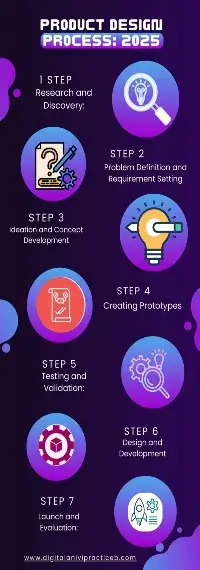
Steps of the product design process 2025

Research and Discovery:

This phase refers to the first stage of participating. In the product designer process where designers collect information and glean insights about users, the present market, and other competitors. These include recognizing the target users, performing market analysis, and collecting user opinions through interviews and surveys. And data processing to figure out what is bothering them. This phase assists in articulating the problem that the product is going to address thereby narrowing down the focus on the design process.

Problem Definition and Requirement Setting

The phase to bring down the problem and set the requirements is where designers utilize the research findings to explain the product they would be designing. This means narrowing or sharpening a simple problem statement that incorporates users’ needs, challenges, unmet market needs, and the designer’s wishes. Designers delineate high-level product goals that address user needs, support business objectives, and are technically achievable.

In this phase, necessities are damaged down into:

  • User Requirements: Functionalities and features that satisfy the expectations and needs of the end users, such as usability, universality, or specific needs design functions.
  • Technical Requirements: Implementation issues include the available budget, whether it can be integrated with already developed systems, and whether there are enough resources or technologies.
  • Business Requirements: Product objectives that are also aimed for by the business. For example profitability goals, market share, and brand objectives.

Clear problem definitions and requirements help to control the design and development process. Keeping all stakeholders on the same page and ensuring the end product is designed for the user.

Ideation and Concept Development

It is a phase in which designers come up with a myriad of ideas to address the detected problem and investigate them further by employing sketches, mood boards, or initial wireframes.

Key Activities in This Phase:

  • Brainstorming: Other methods of achieving this include group workshops or mind mapping activities where every single team member is encouraged to present their ideas to ensure every possible solution has been thought of. Brainstorming assists in breaking down the depression out-of-the-box approach and stimulates out-of-the-box solutions through healthy discussion.
  • Sketching and Initial Wireframing: Designers have to present to them the ideas either in rough sketches or low-fidelity wireframes. This method not only eases the apprehension of the thoughts. But also allows the design to be rather seen than imagined by the stakeholders and the team members.
  • Concept Exploration and Refinement: Designers work on various layouts, color combinations, and features very often producing lots of frameworks in the process. Each framework seeks to address user problems and business objectives but from different angles.
  • Concept Validation and Feedback: The most viable concepts are usually shown to stakeholders. If feasible, to the primary users, and their responses are requested. This serves as a way of testing whether such concepts would be useful or not, in further developing the concepts.

By this stage, most designers will have already decided on one or two winning design concepts to proceed with, based on user and stakeholder feedback. Which clearly outlines how prototypes will be constructed and put under design agnostic iteration in the following stages.

Creating Prototypes:
  • These low-fidelity, high-fidelity prototypes, and everything in between, are created by designers to understand the workings of the product better. Prototypes play an important role in functionality assessment, critique, and redesign.
Testing and Validation:
  • In usability testing, the designers develop a product and test it on real target users in terms of how the product satisfies them and their needs and what can be improved. Testing is always done in stages improving the design of the product depending on the findings from the users.
Design and Development:
  • The design is perfected and specifications are given to the developers so that the building of the product can commence. This is crucial as it helps to ensure that what was intended by the designers will be executed as well as the functionality of the design.
Launch and Evaluation:
  • The product is presented to the audience and the reception of the product is measured using user insights, analytics, and performance measures. Further enhancements are carried out through upgrades based on user feedback and changes in needs.

This mechanism guarantees the complete development of a product that is easy to use and meets the corporate objectives, resulting in feasible, attractive, and scalable solutions.

Frequently Ask Questions

What is the product design cycle?

The product design cycle is a systematic method of preparing a product, covering all stages from identifying the problem, coming up with ideas, making a model, evaluating, improving, and finally producing the product to be sold.


Why is user research an essential step in the process of designing a product?

User Research enables designers to empathize with the users regarding their needs, wants, frustration, and usage. This is essential in developing a product that is people-oriented, functional, and salable.


What is prototyping in design?

Prototyping is part of the designing process in which the designers make mockups of the product, try out how it works, get insights from the actual users about it, and then proceed to the last phase of development. It aids in discovering issues related to usability in the earlier phase thus preventing wastage of time and effort in the latter phases.


How do designers eliminate some of the competing concepts while retaining others?

Designers assess concepts and designs according to user responses, their fit with business objectives, practicality, technology, and overall user experience. The best concepts undergo more refinement and are subjected to more tests.


How does testing relate to the design process in general?

Testing of the product is necessary to ascertain whether it meets the intended purpose or satisfies user needs. Usability testing serves an improvement purpose with imaging from the users’ actual contact with the product before the launch which aids in enhancing the design and working of the product.

How To Use Figma For Web Design

How To Use Figma For Web Design, digitalanivipracticeb

Before knowing How To Use Figma For Web Design. 1st we will understand What is Figma.

What is Figma?

Figma is a robust web design platform developed for use, with the major objective of designing user interface (UI) and user experience for applications. It allows designers to design and share products, prototypes, and design systems on the web in a collaborative and accessible manner.

The functions of Figma such as real-time team collaborative editing, prototyping, and developer handover phases play a significance in enabling success for teams. It allows vector designing and the use of design systems and libraries which helps maintain design consistency across several projects.

The nature of the application enables the use of Figma by teams irrespective of their geographical location and on any device with the internet, hence allowing for feedback in the design process and eliminating the need to keep several copies of the design file. It is widely used in product designing, designing mobile and web applications, and even prototyping making it a multi-functional product to the designers, developers, and other people involved in the design process.

Figma in web design

  • Employing Figma in web design means optimization of its design and collaboration capabilities to build web layouts quickly and efficiently, test them, and improve where necessary. This is how it can be used effectively on web projects.
Set Up a New Project:
  • First, open a blank document in Figma and create new page frames according to the dimensions of your website. Figma has several web templates for both desktop and mobile layouts that can be edited.
  • Begin a new file in Figma, and create frames for the specific device dimensions (e.g. desktop, tablet, mobile) targeted by the design. This allows for responsive design right from the start.
Generate Layout Grids:
  • With the help of Figma’s layout grid option, structuring the web page and aligning the elements becomes an easy task.
  • Grids assist in retaining consistency in responsive design irrespective of the screen size.
  • Make good use of Grids in Figma in bringing out an order in designs. A grid system allows for proper alignment which is very important in attaining a pleasing and functional interface.
Design Elements and Resources:
  • Create generic elements such as navigation panels, buttons, headers, icons, input fields, and so on.
  • Figma makes it easier by allowing duplication and modification of components all over your design for its uniformity.
Employ Styles for Uniformity:
  • Establish text and color styles for consistent typography and branding across the site. This serves to foster an integrated outlook and makes the implementation of any wholesale changes easier if at all necessary.
  • The style system available in Figma ensures that consistency is upheld and that global changes become easier whenever there are any changes in the design color palette or typography.
Prototype and Test:
  • Figma’s prototyping functionality allows for the connections of covered sections in a way that helps in interactive navigation. To give a better preview of the website, one can also include some animations and even transitions and then circulate the preview to stakeholders for their input.
  • End frames and other engagements such as animation page transitions among others to make a cohesive prototype. This function enables the stakeholders to experience the design flow before the implementation phase.
Collaborate in Real-Time:
  • One can give access to the design file to colleagues and clients alike. They can also give comments straight on the design which quickens the entire feedback and editing process.
  • The inclusion of the web-based concept in Figma allows for real-time working where other team members can view the design and leave their comments. This helps in improving feedback loops and minimizing the number of times revisions are done.
Developer Handoff:
  • When the design reaches the final stage, developers, use Figma’s embedded design specs, screenshots of the iOS and Android code snippets, and style guides easing the handoff considerably.
  • Once the design phase is completed, developers can view specifications, and CSS properties, and download assets directly in Figma. This peculiar feature eases handoff, making it easy for development to follow after the designs.

Plugins To Use Figma For Web Design

To simplify the design process activities and help maintain high standards of the design, many Figma plugins have been developed. These are:

  • Autoflow:
  • Unsplash:
  • Iconify:
  • Content Reel:
  • Blobs:
  • Figmotion:
  • Color Palettes:
  • Charts:

The utilization of the mentioned plugins can expand the scope of using Figma in web design with productive means of incorporating and adjusting images, icons, animations, and other elements of the design.

Conclusions

The relevant recommendations and instructions put forward in this section diminish the number of back-and-forth interactions between a designer and a developer during the development phase. In addition, these visual designs supplement Figma’s most basic features so that the web interfaces created within Figma are consistent, interactive, and able to be worked on by several people at once.

Frequently Ask Questions

What is the best way to begin learning Figma as a web designer?

Start by opening a new document and creating frames for the dimensions of the web layout that you would require. For more organization, utilize layout grids and include ready-made elements for more uniformity

Can you build a website in Figma?

Indeed, in addition to the above, Figma also has tools for creating animated interactions with buttons and links, just like how an actual website behaves when navigating through it

Can Figma be used for designing in responsive mode?

For sure. Designers can use the grids, constraints, and auto-layout capabilities of Figma to create designs that easily stretch to fit any screen size without losing the overall composition.

In which way am I able to accomplish sharing my web design project in Figma with others?

The Figma file can be linked to others and they may collaborate on the project and provide their input simultaneously. The design allows stakeholders to leave messages within the image

Can developers use Figma for web design development handover?

Figma also supports the developer’s handover with access to CSS, assets ready for download, and design instructions making the process from creating the design to developing it much easier

What Is Figma Design For 2025

What Is Figma Design For 2025, digitalanivipracticeb

In this article, we will understand What Is Figma Design For 2025

The term Figma Design refers to the design pieces that are made with the help of the Figma tool. Which is pretty much a web-based application used for making the look and feel of computer software and websites – UI/UX design. What Is Figma Design For 2025

  • Figma is an integrated application with features that allow designers. To build, present, and interact with other users with the same content in real time.
  • It is most admired for its user-friendliness and the fact that it is a cloud-based app. Allowing multiple designers to have access to the same work and make changes and updates to it freely.

Figma Use:

Figma is important acknowledged as an interface design, prototyping, and real-time design tool. It is a sophisticated and powerful window-based. Application that enables interaction whether for the design, development, or engagement. The stakeholders in carrying out the digital project regardless of their location. The following are its principal beneficiaries:

Principal Uses of Figma:
  • UI/UX Design: Design user interfaces for websites, mobile applications, and other digital products.
  • Prototyping: Create clickable prototypes that imitate actual users’ experiences, which is useful when conducting user tests.
  • Collaboration: Several collaborators can edit the same design file simultaneously and share their comments with minimal disruptions.
  • Design Systems: Create Design stocks and image banks to provide uniformity among several tasks.
  • Developer Handoff: Provide and embed code pieces for use within Figma. To facilitate control of the process of construction by the engineers easily.
  • Plugins and Integrations: Enhances the design workflow as it allows using multiple plug-ins. To perform various other functions such as animation, icon addition, and accessibility checks among others

Figma’s flexibility, along with the possibility of working in teams makes. It is an undoubtful must-have application. For design teams who aim to create user-friendly and design-integrated digital projects within a short time frame.

The Best Features of Figma

Figma offers an array of advantages that position it at the summit of UI/UX design technology. Alternatively, here are some of its key capabilities.

Inclusivity/Real-time Collaboration
  • This is a feasible opportunity that various participants can access. The same file and work on it concurrently. Features enhancing teamwork and prompt response towards members. Input is provided in real-time, just like Google documents for designs.
Animations & Prototyping
  • Figma allows you to build realistic, interactive, and clickable prototypes with transitions and animations aimed at providing a user experience for testing purposes.
Component System
  • As a designer, you will be able to design various common elements (buttons, icons, form fields, etc). They will be ne edited in one place and every change will appear in all copies, supporting integrity in design.
Auto Layout
  • This deep reliability feature allows designers to build responsive designs, which automatically resize. The design when the elements are changed, facilitates designing for various screen sizes.
Design Systems and Style Libraries
  • Using Figma, teams are allowed to create and maintain their design systems. Consisting of colors, fonts, and other various components, ensuring uniformity across all projects.
Developer Handoff
  • Developers can navigate directly from the design to create CSS, iOS, and Android snippets code. Measure any dimensions, and obtain assets, which minimizes mistakes while increasing the swiftness of handover.
Plugins and Integrations
  • The Figma plugin library includes icons, automating tasks, accessibility checks, and other plugins. Further, the Integration of Slack, Zeplin, and FigJam among other tools enhances the workflow even further.
Web-based and Multi-device-compatible
  • Figma is compatible with all forms of internet browsers and since all projects are saved on the cloud. There is no need for installations or manual updates to enhance usage across all operating systems.

The characteristics above ensure that Figma is an easy and extendable design tool. Suitable for a lone designer or a team that is working on a complete digital experience.

What Is New In Figma 2025

The Config conference in 2025 saw. The introduction of several amazing updates to Figma that were centered on collaborating better and making work processes more efficient. Some of the main highlights include.

  • Design helps from AI: The new AI tools in Figma help execute simple functions. Like adjusting the layout or the colors of a design to quicken the design process.
  • Overhauls’ Cil Management Page: The revised page is fitted with a new UI that has better options. For accessibility and personalization, it is more user-friendly.
  • Improved Prototyping Features: Interactive elements and animation controls have been enhanced. To create more detailed prototypes where designs test out complicated user flows.
  • Improved Handoff to Developers: Increased code export options and integrations. Help in working with development teams by aiding in their design-to-code process.
  • Designs Reimagined: More advanced design systems and asset management extensions. Help groups keep large libraries and modernize their assets across the projects easily.

These enhancements mainly focus on collaboration and automation. And efficiency which makes Figma a more robust tool for UI/UX design in 2025.

Frequently Ask Questions

What does Figma focus on its functionalities for the year 2025?

Figma in the year 2025, is primarily utilized for UI/UX designing, creating prototypes, and designing systems. Several individuals have shifted to the use of Figma since it allows working in teams in real-time. Meaning that it is not only the designers or the developers who work on the project but also the stakeholders. With the use of AI tools and enhanced prototyping tools. Figma is now more pronounced in its role as the do-it-all design platform.


What has been added to Figma? What are the new features in Figma in the year 2025?

Major changes are; the inclusion of a smart assistant while designing UI. A restructured user interface for inclusion, smart prototyping capabilities, enhancement of the developer handoff stage, and improvement of the management of a design system. The above even further expedites the productivity within the operations.


How can Design systems be supported with Figma in the year 2025?

The expansion of Design systems in Figma 2025 made it possible to control. The presence of a large number of assets and their components between teams without losing. Their appearance and making it easy to change them between projects. This contains additional features for managing elements and their sharing between various projects.


Can Figma prototypes be shared and viewed by non-designers?

Correct. The Figma prototypes are able to be distributed using a plain hyperlink. So that any user can access the prototype, and comment. Check the details without signing up for the service which promotes interaction.

Figma Logo Design

Figma Mockups 2025, digitalanivipracticeb

Figma logo design

Abstract Letter ‘F’.
  • The logo of Figma has raw and straightforward elements. But also expresses the main philosophies of the Figma website: teamwork, art forming, and up-to-date design.
  • It has five circles arranged in levels to create an abstract letter ‘F’. In the Figma logo design, the following colors denote different colors of creativity.
Color Scheme:
  • Red
  • Orange
  • Green
  • Blue
  • Purple
  • All of these hues embody uniqueness and adaptability which reflects the usage of the tool by different designers.
Rounded Geometry:
  • The Logo’s rounded forms and soft edges indicate easy application and present a contemporary and approachable look in line with Figma’s approach of promoting a web-based collaborative design platform.
  • It is designed in a flat minimalistic way conserving modern design principles that are however easy to identify with.
Outlined Design:
  • The emblem of Figma has been created while following the principles of Flat Design which is a well-adopted trend in contemporary UI/UX design.
  • This design trend does not use any unnecessary additions such as shadows, bevels, or gradients, therefore, making the design more clean and straightforward.
  • It goes well with Figma’s clean and easy-to-use interface which emphasizes value for users looking at the design process as a ‘workflow’.
Scalability:
  • One brand aspect that is presented in the study is the logo.
  • The Figma logo is quite simple hence can be considered as a logo vertical and horizontal which is a versatile design.
  • Whether on a small app icon or loud on a postcard, the logo is still visible and recognizable.
  • This is based on the fact that it is also important when considering debuting a huge program.
  • Like the digital-first approach that Figma employs which cuts across many screen heights and widths.
Logo Design Philosophy:
  • The straightforward and friendly look of the logo reflects Figma itself.
  • Being the product that enables design from anywhere by allowing multiple people to work on a few projects at a time.
  • The fact that the logo contains shapes that are bold and simple at the same time shows the easiness of the application itself.
  • Hence the easiness in real-time editing and collaboration on designing within the application.
Designing a Logo Similar to Figma:

In case you are creating a logo relative or that is close to Figma, you should remember the following tips:

  • Keep it Simple: Stick to geometric figures and a few details as much as possible to have an effective design.
  • Treatment of colors within the design: Use rich shades to show active levels of engagement and interaction without the colors looking widely different.
  • Trendy and uncomplicated: Use flat designs only, do not include many effects because the aim is to communicate effectively.
  • Design for All Sizes: The design of the logo should be effective for different sizes and applications.
Figma Logo Designing

It is both engagingly challenging and simple as well to design a logo in Figma. Figma has powerful vector tools that make it easy to create a simple and modern logo. Here are three straightforward steps involved in the logo creation process in Figma:

1st step: Workspace Arrangement
  • Start by opening Figma. Then click New File.
  • Select the Frame Tool (F) around which you will make a frame for the logo, for example, a frame of 500×500 pixels.
2nd step: Making Shapes and Elements
  • Begin with the basic shape of the logo using Shape Tools (for example, rectangles and ellipses). Depending on your aspirations, you may also use more advanced geometric shapes such as a ball, a pyramid, or even more natural shapes.
  • Merge shapes by either overlapping them or using Boolean Operations (for example, Union, Subtract, Intersect) to cut out or add shapes together.
3rd: Adding Custom Vectors
  • For brand and other non-standard shapes, the custom vectors can be made by the use of the Pen Tool (P) to make freeform shapes.
  • You can edit shapes by Activating Vector Edit Mode (double-click on the shape), which allows you to reshape a particular editable shape to move anchor points and paths.
4th : Typography
  • If your logo contains text. You may use the Text Tool (T) to insert the brand name or the initials of the brand.
  • Change the Font, Weight, and size available in the Text Properties.
  • Figma comes with different types of fonts, or you may also want to include your fonts if necessary.
5th: Color and Gradients
  • Highlight some of these elements of your logo and then go to the right panel under Fill and select the brand color.
  • You can also include gradients (linear, radial, or angular) by choosing the Fill Type from the given options.
  • Use color harmonies where appropriate for the brand theme since it helps in making the logo balanced.
6: INSERT EFFECTS
  • Go to the Effects section in the right-hand panel to add any shadows, glows, blurs, etc.
  • Use Drop Shadows or Layer Blur depending on whether you want your logo to have a 3d effect or a clean-cut image.
7: Refine and Position
  • Ensure your elements are aligned properly by using the Align Tools located in the toolbar.
  • To ensure they do not mess up the design, Related items should be grouped by selecting them and pressing Ctrl/Cmd + G.
Step 8: Attempt Different Variants
  • Duplicate the design first, and then try out other layouts, font sizes, colors, and so on.
  • Also, use several frames if you want to make variations of your logo for comparison.
Step 9: Logo Save
  • At the bottom right corner of the Properties panel.
  • Select the file type to save (for honors, turn on scale export: SVG, for normal use – JPG).
  • Hit Export to get the logo saved on your device.

Tips for Creating a Good Logo Design:

  • Simplicity: Simpler logos are usually more appreciated and easily remembered. Don’t crowd or avoid clutter.
  • Scalability: Make sure your logo works well at all sizes, from small business cards up to large billboards.
  • Color scheme: Keep a uniform color scheme and strategically plan how your logo will appear colored and non-colored.
  • Effort for uniqueness: Ensure the proprietors make the logo with appropriate features so that it enhances important attributes.
  • To achieve the goals a modern date logo design can be achieved in Figma Designer which will correlate with your marketing strategies.

To achieve the goals a modern date logo design can be achieved in Figma Designer which will correlate with your marketing strategies.

https://digitalanivipracticeb.com/what-is-sequence-in-premiere-pro/

Frequently Ask Questions

What is the meaning of the Figma logo?

The brand Figma focuses on simplicity, creativity, and teamwork. The colorful figures which are placed one on top of the other depict an abstract form of the letter F i.e. the main purpose of this tool, which is designed to aid in the collaboration of designers modern safe, and easy way.


The Figma logo is composed of many colors why?

Figma logo consists of five — red, orange, green, blue, and purple — to represent multiculturalism, creativity, and versatility of the design tools. Each corresponded with the wide range of tools available in Figma catering to all sorts of users


What is the Figma logo made of?

The Figma logo adheres to the principles of flat design. It does not include complex elements such as shadows, or gradient effects, instead, it emphasizes minimalistic clarity with scalability. This simplistic and modern flat look is in sync with the interface of Figma which is simple and user friendly.


In what way does the Figma logo display the purpose of this brand?

The sheer simplicity of the logo along with its bright colors and rounded shapes reflects Figma’s goal of making design tools and resources useful to every user, irrespective of their skill level- rookie or professional. The tasteful design of the logo is also representative of the ease with which Figma is able to be used by people.


So, is the Figma logo resized well?

Certainly, the Figma logo has a very high level of resizability. Thanks to its neat and uncomplicated graphics, the design is identifiable and clear regardless of the scale whether it is a tiny app icon or blown up on screens and marketing material.

Figma Download

Figma Download, digitalanivipracticeb

Figma Download means more often than not getting a copy of the Figma software and installing it on your device. This is because Figma is also a web-based designing tool. And therefore does not require downloads the way traditional software does. However, it does come up with desktop applications for both Windows and Mac operating systems.

To Download Figma:

➢ Go to the Figma website. ➢ Look for the Downloads tab. ➢ Select the Figma Desktop App for your computer (Windows or macOS). ➢ Adhere to the installation procedures to install the software.

Figma is associated with free mobile applications as well. Both iOS as well as Android, are perfect for watching and reviewing the designs optimized for a mobile device. The Desktop app includes additional capabilities. Such as being able to work offline and better performance while still keeping the same basic functions as the web version.

How can one effectively get Figma and use it?

Desktop App for macOS and Windows

The app that can be used on desktops is offered on both macOS and Windows systems, and it contains an offline mode and a performance enhancement compared to the web version. To get Figma:

  • Find the downloads section of Figma.
  • Click on the appropriate download links for macOS or Windows.
  • Download the application by adhering to the instructions given on the screen.
Mobile Application for IOS and Android

Figma has developed mobile apps (Figma Mirror) for both the iOS and Android operating systems, which enable you to check your designs on mobile platforms instantly.

  • For iOS: Download using the app store.
  • For Android: Download using the Play Store.
Access via a Web Browser

Figma is generally a web-based application so you do not need to download it but rather access it in any of the available browsers:

  • Go to Figma.com.
  • Log in or register to access the designing features immediately in the browser and not any other application.
Figma Plugins and Integrations

It has several plugins and integrations that it allows and helps add to its functionality. These are done and installed straight where you use Figma:

  • Launch Figma and select the Plugins option located in the Resources menu.
  • Search, add, and control the use of plugins available in both desktop and web applications.
Offline Access

The desktop app lets users access documents without the need of the internet thus enabling the designing users to do some work even when not connected to the internet. Any changes done offline will adjust themselves upon the restoration of internet service.
With these methods, Figma can be reachable on various platforms and devices thus enabling a continuous designing process irrespective of one’s location.

System Requirements for Desktop Application
  • Mac OS: The latest OS supported is Mac OS 10.12 (Sierra).
  • Windows: Effective with Windows 8.1 and above versions. The application supports both Intel and AMD processors.
  • Make sure that your computer satisfies these criteria to fully enjoy the Figma desktop application.
Figma Installation on Linux
  • Figma, however, does not have an official app for Linux but it can accessed through a web browser without restrictions on the Linux distribution.
  • A good number of them use Wine to help them install the application on their systems or download and install a GitHub package called Figma-Linux, which does the same, but these methods are not supported officially.
Making an Account on Figma

Figma wants you to have an account first, so if you want to install the gig and use it, you have to:

  • Head to the primary page of Figma and Find a Button That Says Sign Up.
  • Email users may especially want to do this or existing users may import their Google, Microsoft, or SSO accounts (if applicable in your organization).
  • After signing up, the user can use the application using either a web browser a desktop, or a mobile Figma application.

Types of Figma Account:

  • Free Plan: Core features are available with three Figma files and limitless personal projects. The plan is commendable for individual utilization or starters.
  • Professional Plan: Extends to unlimited projects, version history, team libraries, and beyond. This is appropriate for individual workers or small teams.
  • Organization & Enterprise Plans: Superior capabilities such as administration controls, single sign-on, private add-ons, and exclusive assistance for big staff and corporates are incorporated.
Ensuring Consistency and Collaborating in Files Maintaining Different Devices.

All design files are in cloud storage, hence the files can be accessed and synced across different devices easily.
It is very easy to share; you simply copy the link of the file or use the Figmas share option and enter the emails of the people you wish to share the document with. You can also set the level of access that they have whether they can view, edit, or comment.

Organizing for Team Work
  • Real-time editing and working with visual designs is one of the major strengths of Figma.
  • Available concurrently for viewing, commenting, and editing by several users with all the changes reflected in real-time.
  • Every user can also be allocated a particular category like Viewer Editor, or Admin based on their needs of access.
Employing Figma in Academic Environments
  • Figma provides students and teachers with professional tools at no cost.

In combination with Figma For Education, you can:

  • Take advantage of all the benefits of the Professional plan.
  • Work with your peers and instructors.
  • Apply through the education section of Figma’s website.

Figma Community and Resources

  • Figma Community: another section of valuable utilization where you can find several files, templates, and plugins that have been uploaded by other users.
  • You can browse the resources available in the community and use its contents to improve your work.
  • Learning Resources: On its website, Figma avails so many useful materials such as tutorials webinars, and other documentation, which will assist you in learning even the most complex features with great ease.

Figma is very flexible and supports many platforms and hence is very useful to any designer, providing a wide range of functionalities and easy use on different devices and systems

Frequently Ask Questions

Is there an option to use Figma without an internet connection?

Figma’s desktop application for macOS and Windows platforms has offline capabilities. You will not be required to be connected to the internet to work on your designs and any updates made will sync when the connection returns.

Is it possible to install Figma on a Linux machine?

Figma does not offer a standalone app for Linux, however, the application is web-based in Linux operating systems. Some people use things like Figma-Linux or Wine to use desktop applications, but those apps are not endorsed

On what platforms can you download the Figma mobile application?

Figma and other mobile smartphone applications like Figma Mirror which is used to preview designs are available for iOS and Android. These applications are useful for viewing and interacting with one’s designs on mobile, however, they do not allow for complete editing of the designs

What Is Figma Used For 2025?

User UX Research Process 2025: Boost Engagement and Traffic. digitalanivipracticeb

Figma is a multifaceted design application used mostly in UI/UX design, prototyping, and building design systems. Mainly, it is web-based which allows designers to carry out their design projects in real-time, provide feedback, and collaborate in the process. From these lines, you can understand What Is Figma Used For 2025?

Below are the major uses of Figma:

User Interface (UI) Design:
  • Figma is often adopted to create the interface design of websites, mobile applications, and other digital products. It has the features of layout, typography, and incorporation of images, icons, and other elements. To ensure that the interface is not only presentable but also easy to use.
User Experience (UX) Design Prototyping:
  • With Figma, designers can also develop interactive prototypes that replicate the user experience. Designers can also add navigation between screens through links, animations, transitions, and the like to demonstrate. How user flows occur and to test interactions. This is simple because one can see how users will move through the product.
Collaborative Design:
  • In Figma’s case, this refers to the ability to work on the same project at the same time. Hence, enabling the simultaneous contribution of multiple people to the same project. Large and small-scale designing and editing tasks can be distributed among designers, developers, and stakeholders. Since Figma allows everyone to view and comment on designs. It is a suitable tool for teamwork and project evaluation.
Design Systems and Component Libraries:
  • Figma allows teams to develop elements such as buttons, characters, or even form fields, which can also be incorporated into design systems and repositories. This creates uniformity in projects and enhances. The pace of the designing phase as components can be altered or reused across the whole system.
Developer Handoff:
  • The handoff to developers is also made easier. In Figma, several tools are available in the workspace for the inspection of design properties and code, dimension, and color information. This allows developers to get the designs and the required information. Hence making the handover from designing to developing seamlessly.
Wireframing:
  • Another example of the use of Figma is wireframing which refers to the act of producing rudimentary . Designs or images depicting the arrangement of elements in a product. This is important in allowing the designers to first lay the skeleton and operational aspects of a product before delving into the specifics of UI designs.
Development of Graphics:
  • In Figma, the graphical designers can design several visual elements which include icons, illustrations, graphics for social media, and other visual elements. Such elements can be exported into different file extensions among them PNG, SVG, and JPG for digital or printed material usage.
Mockups and Presentation Design:
  • Figma has a wide range of design features that extend to the provision of good-quality mock-up and presentation designs. Images and texts with animated effects can be added to the presentation which makes it ideal for the creation of video and slideshow presentations.

These are the main points What Is Figma Used For 2025?

What type of tool does Figma fall under? Is it a UI design tool, or a UX design tool?

  • Figma is a tool for both UI (User Interface) and UX (User Experience) design. It has features that facilitate many areas of UI and UX design. Which makes it a suitable tool for designers involved in developing digital products.
  • Figma acts as an all-encompassing UI and UX design application enabling designers to perform tasks. Ranging from wireframing and prototyping (UX) to extensive visual designing and components hierarchy (UI). This flexibility also makes it a preferred option for designers who are creating a digital product.

Is Figma difficult to learn?

On the contrary, If you look at the consensus, learning how to operate Figma is easy particularly for first-timers or people who are accustomed to graphics software such as Adobe XD, Sketch, or Photoshop.

Suggestions for learning Figma in no time:
  • Begin with the Basics: Figma Word on the Web has its how-to-use it as well as a video on how to use it posted on YouTube to understand the basics.
  • Try the Sample Kits: Use availed sample kits from Figma. Which you can use and change as you want. This helps grasp the layout in which projects are designed.
  • Tackle Real-Life Situations: Work on very basic real-life skills when it comes to small projects where applying these attributes is a personal portfolio in addition to designing a simple application.
  • Take Part in the Networking Activities: Interact with the Figma audience to obtain useful information in the form of advice, and samples. And any other information that would be useful for designers.

More so, Figma is easy to use hence a perfect software for beginners and even advanced designers wishing to improve their skills in UI / UX design.

Frequently Ask Questions

What is the main aim of using Figma?

Figma is meant primarily for UI and UX designing, allowing designers to fit in elements for websites, mobile applications, and other digital media products. It comes with tools for wireframing, high-fidelity design, and prototyping making it a one-stop platform for the design life cycle

Is there any collaboration in Figma?

Yes. Figma supports real-time collaboration and multiple team members can work on the project simultaneously. Designers, developers, and other relevant personnel can enjoy viewing, editing, and commenting on the designs in real-time therefore it’s suitable for teamwork and distance working.

Is Figma suitable for developing design systems?

Of course. Figma enables even design system creation, which involves managing a collection of style components, assets, and other things for easier use. Therefore, it helps the team maintain uniformity no matter the projects worked on and speeds up the designing and development stages.


UI Figma in 2024

UI Figma in 2024- digitalanivipracticeb

Before we start with UI Figma, let’s understand What UI and Figma are. Then we will understand UI Figma in 2024.

What is UI?

The term UI (User Interface) comprises all the visual and interactive components that a user deals with while using a digital product. Be it a website, a mobile application, or software on their PC. The essence of a UI is to create an easy-to-use yet pleasant environment that enables the user to operate the product efficiently and effortlessly.

Essential Elements of UI:

  • Visual Design: This refers to the aesthetic aspect of the interface, including but not limited to the palette, font type and size, spacing, and arrangement of components.
  • For example, a simple purist design with the elements arranged in order improves the design’s usability.
Interactive Elements:
  • These include the various components of the interface the user operates like buttons, clickables, forms navigation menus, and sliders.
  • For instance a ‘Submit’ button out of the Form field, or a searching space in which a user interacts by entering the desired query.
Icons and Symbols:
  • These small images denote an action, object, or idea. These are particularly helpful in making the users aware of the actions that they can perform.
  • For instance, a search embedded in a magnifying glass image or a settings icon in a gear image.
Typography:
  • These are text presentations within the user interface that call for appropriate font size selections, font style, and arrangement of text.
  • For instance, titles can be in bold font, while the rest of the body will only use regular font to ensure hierarchy.
Layout:
  • The positioning of the UI controls on the screens such that the ordering and arrangement of the information presented is logical and easy to understand. And also facilitates the smooth navigation of the users across the interface.
  • For instance, using a grid layout to make sure all the elements are in rows and columns makes it easy to manage

What is Figma?

Figma is a favored design platform among UI/UX designers. It is accessed online to carry out tasks such as user interface design, prototype design, and development of design systems. The tool facilitates team working in real time between members of the design team. Therefore it is appropriate for any product to be digital eg websites, mobile applications… etc. Here is how Figma performs the function of UI designing.

Main advantages of Figma for UI:
Real-time Interaction:
  • Since Figma allows team members to take part in the same design at the same time, it is perfect for team design. All changes are visible at the same time so there is no need for redundancy in changes done to different file copies.
2D Drawing/ Vector-Based Design:
  • Figma is a vector design software other than raster which implies all the designs prepared are in a vector form and can be scaled to any size without any pixelation.
  • This is very important in the case of making UIs that are responsive to different screen sizes.
Design Systems And Components:
  • Figma has provisions for making distinct elements, for example, buttons, icons, or input fields, which can be used in several places in a project and can be easily redeployed whenever needed.
  • This prevents errors in design and eases the complexity of design especially when one is designing a rich interactive interface.
Transitional Animation/ Prototyping:
  • You can connect the user interface screens to make interactive prototypes within Figma. This is how designers can create user flows and clickable prototypes for testing before development.
Handoff to Developers:
  • Figma makes the process of hand-off to the developers easier since the developers are given everything. They are required to affect the design including the appropriate sizes, colors, and even the CSS codes of the designs.
Design across various Devices/ Responsive Design:
  • Figma encourages designers to constrain and set rules for auto-layouts which allows for the creation of responsive designs.
  • This means your design will adapt to different sizes of screens i.e. mobile screen, tablet and desktop.
Destinations/ Plugins:
  • Figma has many plugins that increase its capabilities. Including accessibility tools, animation, and productivity enhancers to streamline the processes involved in UI Figma in 2024.

Benefits of Using UI Figma in 2024:

  • Universal Application: Figma is web-based so it can be accessed on any type of operating system (Windows OS, Mac OS, and even Linux) with internet connectivity only.
  • Management of Project Versions: Any design within Figma is saved whereby it is possible to know what changes were made when and also go back to earlier versions if need be.
  • Element Library Sharing: Design libraries can be created within a team of designers and made accessible to all the members of the team. To eliminate inconsistency of UI elements across design work in different projects and teams.
  • Simplicity: Figma has a simple interface that a beginner can adapt to very easily thus enabling a new user to learn designing UIs in a short period.

Few Examples of using UI Figma in 2024:

  • Creating the user interfaces of websites, smartphone applications, or software applications.
  • Making high-fidelity designs to show how users are going to interact with it.
  • Creating a design hierarchy to ensure all products portray the same identity.
  • Working with other creative designers, developers, and other stakeholders concurrently.

Figma is now a must-have tool for UI designers. Due to its robust features, ease of working together, and versatility when designing on different screens.

Frequently Ask Questions

What do you mean by Figma?

Figma is a modern design tool primarily focused on UI/UX designs. It is a cloud-based application with the necessary capabilities for design, prototyping, and real-time collaboration. This makes it suitable for developing layouts for websites, mobile apps, or any form of digital media

Is Figma paid or free?

Figma has a free plan which comprises of simple features generally acceptable by an individual or a small team. On the contrary, there are more expansive paid options available, including those designed for group work, high-level screen transitions, and management of a design system

Can I invite others to work on my design in Figma?

Of course. Another thing Figma is famous for is that you can work on the design even at the same time with other team members and leave comments for each other to view, hence perfect for group work designs

How do I prototype in Figma?

To create a prototype in Figma, there are interactive connections that join frames (also known as artboards). You simply pick an object (a button, for example) and with the help of the prototype tab, reach out to the appropriate frame with a line. You can then define how and when the link will be activated, for instance, by assigning when the user clicks.

What are Figma components?

Figma components are design elements that can be created once and reused all over the project. If you change one component, every single place the component exists within your design will change, making it easy and quick to have a consistent design.

Iconography Design

Iconography Design, digitalanivipracticeb

The digital interface’s creation and utilization of icons are embodied in the design of iconography. They are small symbolic graphics that help simplify communication. Provide direction for users, and enhance navigation. Thereby improving overall user experience. Well-designed icons are intuitive and also enhance clarity and usability in any digital product.

Fundamental Guidelines for Iconography Styling:

  • Simplicity: Icons ought to communicate their meaning quickly and straight away. Avoid adding too many details or unnecessary things into them that would make the icon complicated.
  • Consistency: Icons must follow a certain style across the entire interface. This includes keeping a similar shape, size, thickness of lines, colors, and visual weight to maintain balance.
  • Clarity: The main goal of icons is to communicate ideas in an easy-to-understand manner. Therefore opt for these designs which are known across the globe and leave no room for uncertainty.
  • Scalability: Icons should be built with scalability in mind so that they can effectively serve both small-scale and large-scale images without losing clarity or details.
  • Context Relevance: The symbols should be in line with the work they are meant to convey. For instance, a trash can pictogram should mean “remove,” whereas a speculum is often interpreted as “inquire.”
The following are different kinds of icons:
  • Functional icons: These are specific tasks represented by icons like “save” and “edit” for example.
  • Navigation icons: These help users navigate various aspects of the interface and include a button labeled “home” or an arrow pointing back.
  • Status Icons: Some symbols show whether something is in good condition or not such as a circular indicator with dots inside it that turns on while files are still uploading before turning off once all files have uploaded successfully.
  • Object-based Icon: Representations include such things as documents, folders, and images.
  • Social Icons: Representative Social Media Platforms include chat, Facebook, and Twitter amongst others.
Illustrative practices of making icons
  • Employ Familiar Metaphors: Use popular symbols that guarantee immediate recognition, such as a shopping cart for “add to cart” or an envelope for “email”.
  • Look this way and you will see it offered in your local store by companies providing texting services at relatively higher rates. Some people opt for mobile applications while others prefer websites, which are also accessible via smartphones or tablets. You can get their services from any point around the world. Since they have made sure that their platforms are compatible with almost all devices including iPhones, Androids, and BlackBerries.
  • Adopt the right coloration schemes: Maintain harmony with product design in terms of colors. And use different colors to depict conditions (e.g., red used in errors, green used in success).
  • Good practices will ensure your symbols convey meaning from the start and meet their expected purpose.

Despite being consistent in terms of referring to images, the words iconography and icon design are different in meaning

Iconography:
  • Definition: Iconography is concerned with the symbolic significance and employment of icons in a given context, system, or culture. It deals with the global study and interpretation of images as signs of history. When they transmit certain meanings or ideas. Iconography includes all about ways we use and comprehend them visually.
  • Focus: Iconography discusses the significance of symbols and their meanings conceptually or culturally. This includes how they convey messages, symbolize activities, and are interpreted by people. It focuses more on the functions of such elements within some system (for example, in an interface, a holy book, or artistic studies).
  • Example: For instance, within a digital interface across various applications. Iconography looks at how the ‘heart’ symbol is recognized as signifying either a “like” or “favorite” action.
Icon Design:
  • Definition: Icon design is the art of designing individual icons. It is a combination of artistic and technical abilities necessary for making visual symbols that are simple, functional, and beautiful. The focus of icon design is to define the icon’s visual appearance, style, and usability.
  • Focus: Icon design is concerned with one thing – creating and visually designing icons. This involves deciding on their shape, line weight, color, size, and consistency so that they may be clear and functional within different contexts.
  • Example: One aspect of icon design would be the creation of the ‘heart’ icon which has clean lines, suitable scaling, and follows the app’s design system.
Basic Differences:
  • Scope: Icon design is particularly centered on the development and design of icons. Iconography is a wider subject matter encompassing meanings as well as their interpretations.
  • Focus: An understanding of symbols portrays the purpose they serve alongside. How they are perceived. Iconographers create such symbols in a manner that is not only visually appealing but also adheres to some defined stylistic order.

To sum it up:

Iconography focuses on the cultural as well as contextual meaning. The icon design is about the process used to create them.

User experiences can be greatly improved through iconography. Design that follows the principles and best practices of generating implicit visual signals for ease of navigation and use.

Frequently Ask Questions

What is the purpose of using symbols in design?

Iconography design is the process of using icons to create and communicate meanings, actions, or objects. In digital interfaces or products. It emphasizes developing simple, customizable, and constant-looking pictorial representations that will facilitate easier user interaction

Why is iconography important in UI/UX design?

Cognitive understanding of what an interface entails is primarily based on its design elements such as colors, and shapes including their sizes. Therefore, for this reason, it can be said that icons play significant functions within a UI/UX context. Well-thought-out symbols alleviate mental stress; they improve usability while enhancing that all-important emotional connection between users and systems They also represent complex concepts through concise visualizations

What Makes an Effective Icon?

An effective icon should be:
Simple: Easily understandable at a glance. Recognizable: Universally familiar or intuitive. Consistent: In line with the overall design language and style of the product. Scalable: Clear and functional at both small and large sizes. Relevant: Appropriately represents the action or object it is associated with.

What is the Difference between Iconography and Icons?

While icons are symbols used within that system, iconography refers to the broader system or collection of icons used to convey visual meaning in a specific context (e.g., an app’s navigation system). Iconography also deals with the interpretation and meaning of the icons, while icons are the tangible visual elements themselves

What are some of the strategies for ensuring consistency in designing icons?

To maintain uniformity in iconography design:
Keep all icons within one inclusive theme (for example, an even stroke width, color uniformity, and similar shapes).
Apply a scaled-up grid system to all designs.
Stick to metaphors and visual indicators that help users identify particular items.
Make all icons possess nearly equal sight mass and equilibrium hence creating equilibrium on the interface.

Optimized with PageSpeed Ninja